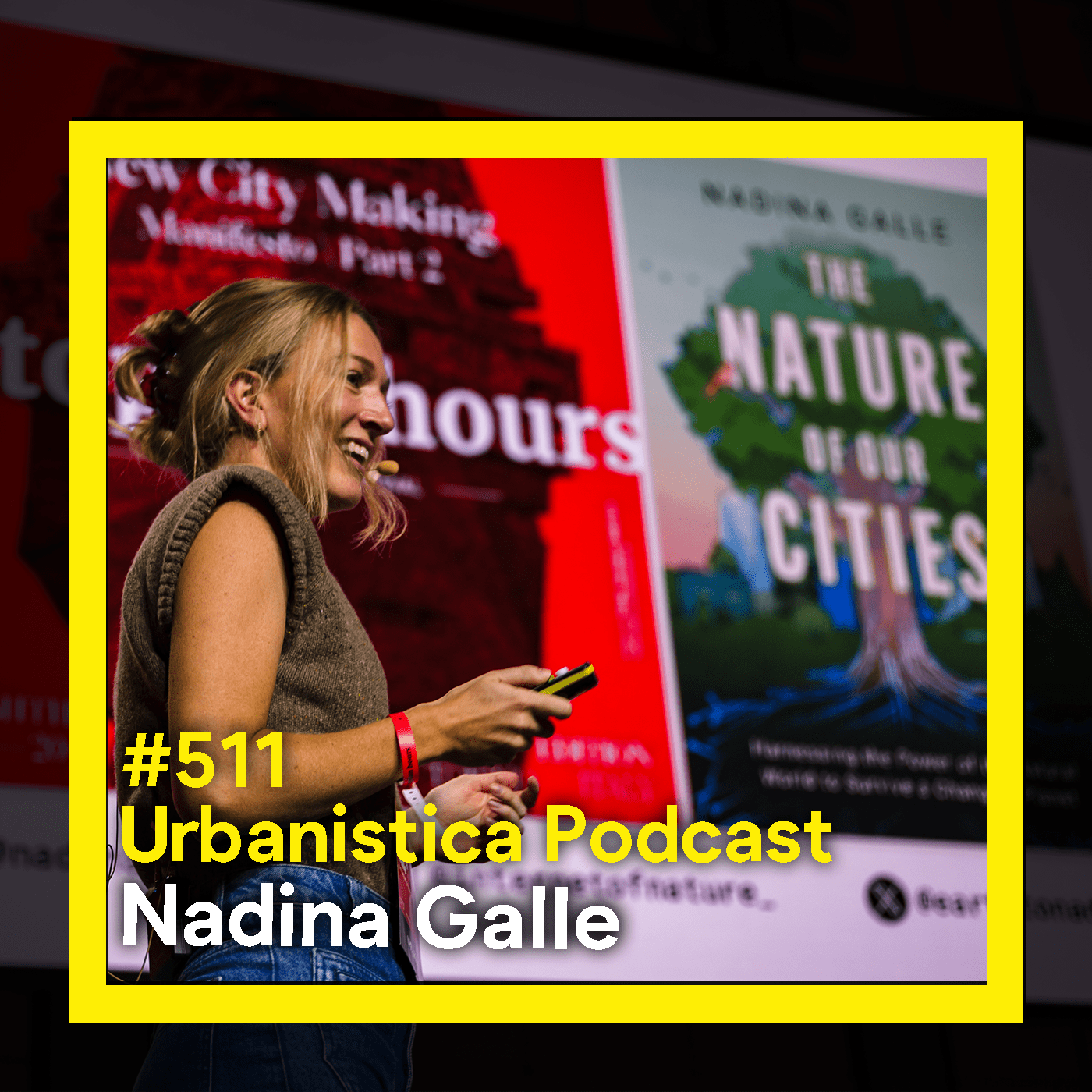
In a world increasingly defined by concrete and code, urban ecologist and technologist Nadina Galle is leading a quiet revolution: bringing nature back into our cities—not just with trees and parks, but with intention, empathy, and smart technology.
Nadina joined Mustafa Sherif on the Urbanistica Podcast for a wide-ranging conversation on why cities are losing greenery, how tree-planting campaigns often miss the mark, and what it really takes to reconnect people with the natural world.
“We’re obsessed with planting more trees, but we forget about caring for the ones we already have,” Nadina explains. “It’s not about quantity. It’s about the right tree, in the right place, with the right care.”
Why Urban Nature is Disappearing
Despite well-meaning campaigns to plant “a million trees,” the data shows that greenery in cities like Amsterdam, Toronto, and Sydney is actually decreasing. Much of the loss happens on private land—an area that’s often outside of municipal control but critical to a city’s green footprint.
Nadina emphasizes the need to focus not only on planting new trees, but also on preserving and maintaining existing ones—especially mature trees that deliver far greater benefits for air quality, cooling, biodiversity, and well-being than younger ones.
“The benefits of trees multiply as they grow. A single mature tree can do more for public health and climate adaptation than ten newly planted saplings.”
From Tree Planting to Tree Parenting
One of Nadina’s key messages is a call to stop chasing flashy tree-planting numbers and start focusing on long-term care. She draws attention to the “teenager trees”—those growing up but not yet mature—which often get ignored in favor of freshly planted seedlings or old heritage trees.
She also cautions against planting trees in remote places just to meet climate goals, while cities themselves remain under-greened.
“We need to stop seeing trees as a checkbox on a sustainability plan. Instead, we need to integrate them as living, breathing infrastructure.”
Greening the Urban Jungle
Even the densest cities can become greener, says Nadina, pointing to examples from Paris and Singapore. Whether it’s mobile plant beds on wheels, vertical gardens, rooftop forests, or modular “green leasing” models like the Urban Jungle Project in the Netherlands, cities are finding creative ways to embed nature—even in the tightest spaces.
A favorite framework she references is the 3-30-300 Rule by Dr. Cecil Konijnendijk:
- Every person should be able to see 3 trees from their home
- Each neighborhood should have 30% canopy cover
- Everyone should live within 300 meters of a green space
“It’s a simple but powerful way to measure access to nature and to make sure greenery isn’t clustered only in affluent areas.”
The Internet of Nature
At the heart of Nadina’s work is what she calls the Internet of Nature a next-generation approach to urban ecology using data and technology to manage green infrastructure more effectively. From sensor-based irrigation and tree-climbing robots to AI biodiversity mapping and citizen science apps, Nadina sees tech not as a threat to nature, but as a bridge back to it.
“Nature is unpredictable. But with the right technology, we can understand it better, care for it better, and integrate it more deeply into urban life.”
A Book, a Movement, a Mission
In her new book, The Nature of Our Cities, Nadina shares the stories of people and places redefining urban nature. It’s not just a catalog of technologies; it’s an emotional, narrative-driven journey through the challenges, breakthroughs, and dreams of those rewilding our built environments.
“I want every child to grow up with a deep connection to nature. We don’t need more national park visits once a year. We need nature in our daily lives.”
What Cities Should Start—and Stop—Doing
So what’s her prescription for cities?
Stop:
- Focusing on quantity over quality
- Ignoring tree maintenance and mid-growth care
- Spending time in green spaces while glued to a screen
Start:
- Adopting the 3-30-300 rule
- Mapping and managing biodiversity with precision
- Building micro-forests on schoolyards (think Miyawaki method)
- Inspiring citizens to identify local species and see themselves as caretakers of their environment
Final Words from Nadina
To the global audience listening in from over 140 countries, Nadina offered three simple but powerful calls to action:
- Get outside and explore what’s already around you.
- Learn the names of the trees, plants, and creatures that share your space.
- Join a community of people working to protect and expand urban nature—whether it’s through citizen science, gardening, or just spreading the word
Learn more about Nadina and her work: www.nadinagalle.com
Listen to the podcast here
Apple podcast
https://podcasts.apple.com/se/podcast/511-the-nature-of-our-cities-nadina-galle/id1503039952?i=1000703308734
Spotify (video)
 Mustafa Sherif